Introduction: thermal comfort as a key factor at sea
On a ship — whether it’s a ferry, a cruise liner, or a work vessel — the wellbeing of people onboard is far from secondary. Ensuring consistent thermal comfort is crucial both for passengers enjoying common areas and for crew members spending long hours in operational spaces.
The challenge, however, is that heating in a maritime environment comes with unique difficulties: small cabins, exposed working decks, large lounges constantly opened to the outside. Traditional systems, such as air heaters or fuel-based stoves, don’t always provide the right combination of efficiency, safety, and uniform heat distribution.
In this context, radiant floor panels represent an innovative, modular solution. By turning the floor itself into a discreet, evenly heated surface, they address many of the typical challenges of the naval sector — cutting energy consumption while improving onboard comfort.

The challenges of heating in the naval sector
Heating a ship is nothing like heating a building on land. Onboard, conditions and spaces change constantly, making the issue far more complex.
Think about the interior spaces: cabins are compact, while common areas can host hundreds of people. Then there are working decks, often exposed to wind and humidity. It’s clear that one centralized system cannot handle all these needs equally well.
The marine climate adds to the challenge: high humidity, air circulation, and salinity put every system under strain. Air-based heating, for instance, struggles to maintain stable temperatures and often consumes large amounts of energy.
For shipowners and shipyards, the other key factor is efficiency. Every kilowatt saved reduces operating costs and lowers emissions, a central issue for meeting today’s environmental standards.
Here, modular radiant floor panels offer a different approach: they heat only the areas actually in use and do so evenly, from the floor up. It’s a discreet technology that enhances comfort without wasting energy on unused volumes.
Those interested in real-world applications and further insights can explore the Insights section of the website.
How radiant floor panels work onboard
The idea is simple: transform the floor into a surface that distributes steady, comfortable heat. Radiant panels use modular electric technology, designed for environments where heating must be quick, safe, and non-invasive.
Each panel works like a tile: it can be installed independently or linked with others to cover larger areas. This modularity makes the system flexible and ideal for different spaces, whether a cabin, a dining room, or a technical deck.
Unlike air systems that heat the overall volume, radiant panels distribute heat from the bottom up, exactly where people and equipment are. The result is immediate comfort without unnecessary waste.
Safety is another crucial factor. Onboard ships, the use of fuel stoves or complex systems carries significant risks. Radiant floor panels, by contrast, involve no open flames and no emissions, and can be controlled with straightforward, reliable management systems.
For refitting or new builds, this technology is a ready-to-use solution: it integrates easily with other onboard systems and requires no invasive works. Further details and technical specifications are available on the Radiant Floor Panels page.
The benefits of radiant floor panels for the naval sector
When it comes to onboard heating, it’s not just about raising the temperature: what really matters is the comfort experienced by people. Radiant floor panels are designed exactly for this, providing safe, uniform heat without waste, adaptable to the many different areas of a ship.
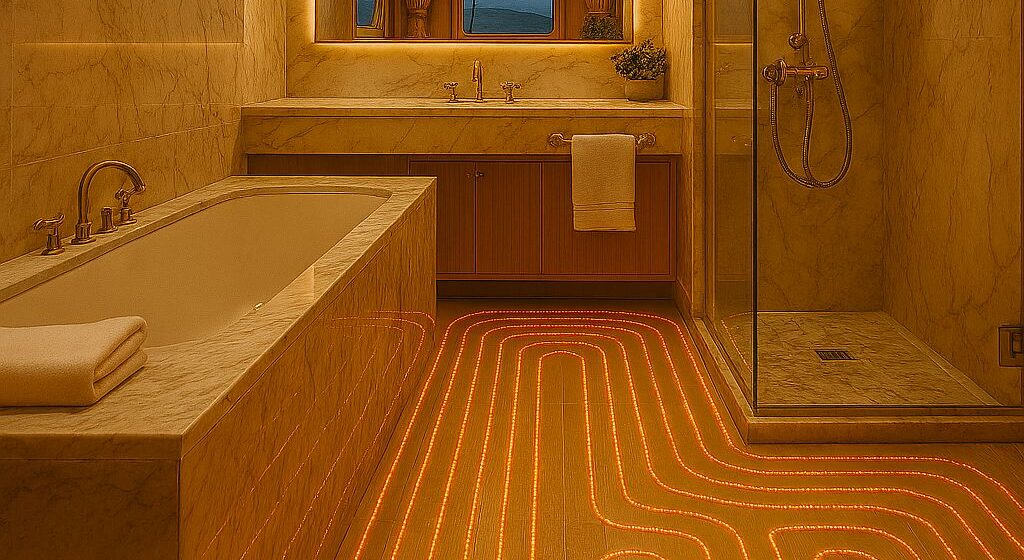
1. Comfort for passengers and crew
Anyone traveling by ferry or cruise ship knows how an unheated or chilly environment can ruin the experience. People tend to spend less time in common areas, limiting social interactions and onboard services. With radiant panels, heat rises evenly from the floor, creating a welcoming atmosphere right away.
For the crew, the impact is just as important. Spending hours on a technical deck or in operational zones without adequate heating means fatigue sets in faster and concentration drops. Radiant panels keep temperatures stable exactly where needed, improving both safety and working conditions.
2. Reduced energy consumption
Traditional systems often waste energy: hot air rises quickly, leaving colder zones near the floor where people are. To compensate, the system has to work harder, which increases consumption.
Radiant panels flip this model: they deliver heat from the floor upwards, targeting only the spaces actually used. The result is the same comfort with far less energy. For shipowners, this means lower operating costs; for the maritime sector, it also supports environmental compliance by reducing emissions.
3. Increased safety onboard
Unlike fuel-based stoves or air generators, radiant floor panels involve no open flames and no overheated surfaces. This dramatically reduces fire and burn risks — critical in an enclosed environment like a ship. Plus, there are no emissions, meaning cleaner, healthier air for passengers and crew.
4. Modularity and adaptability
Cabins, corridors, dining rooms, technical areas: every ship has differently shaped spaces. With their modular design, radiant panels can be installed exactly where needed, without invasive infrastructure. They are perfect for new builds and equally suitable for refitting projects, where installation speed is crucial.
5. Simple and reliable management
Electric radiant systems are easy to control: a single panel can adjust temperature and consumption with precision. The crew doesn’t need to manage complex maintenance, and monitoring comfort levels becomes straightforward.
For more technical advantages and comparisons with traditional systems, visit the Insights section.
Practical applications of radiant floor panels in the naval sector
One of the greatest strengths of radiant floor panels is their versatility: they can be adapted to many vessel types, always with the same goal — ensuring comfort while saving energy.
- Passenger ships and cruises
Large vessels like cruise liners have vast spaces to manage: dining halls, theaters, lounges. Radiant panels allow targeted heating only where guests are, improving comfort without driving up consumption. - Ferries and commuter lines
Here, operational continuity is essential. Passengers usually take short, frequent trips, and a comfortable environment makes a real difference in how the service is perceived. Modular panels reduce downtime for installation, a major advantage for operators who cannot afford long dock stays. - Yachts and luxury vessels
Onboard comfort is a must. Owners expect solutions that are discreet, elegant, and safe. A radiant system integrated into the flooring heats the environment without clutter, preserving clean interior design and offering a level of comfort consistent with luxury standards. - Workboats and technical vessels
On operational decks and technical areas, the priority is crew safety. Radiant panels provide localized heating in working zones, improving operating conditions and reducing fatigue caused by cold.
To explore more case studies and applications — not only in the maritime sector but also for events and temporary installations — visit the Insights section.
Conclusion: innovation and reliability for onboard comfort
Onboard heating is no longer just a technical detail: today it’s a strategic factor that directly impacts passenger experience and crew working conditions.
Naval radiant floor panels offer an innovative response: a modular, electric, safe, and adaptable system that reduces consumption while ensuring localized comfort in any part of the ship.
With this technology, HSI Italia brings to the maritime industry the expertise already gained in events and temporary structures, once again proving its ability to deliver innovative, practical solutions.
If you are a shipyard, a shipping company, or an owner planning new installations or refitting, now is the right time to consider integrating radiant panels onboard.
Request a tailored consultation via the Contact page: our team will analyze your project and recommend the best solution to guarantee safe, efficient comfort at sea in every season.